Supply chains fail
quietly.
A pressure-propagation strategy game built from real industrial dynamics. Keep the network alive. Every action counts.
Could you have done better?
These are real disasters that reshaped global supply chains. Play through each one — make the decisions executives actually faced, and see how your outcome compares to what really happened.
Milwaukee, WI — global supply chain
Q3 2022 Supply Chain Write-Down
$225M inventory write-down; Q3 EPS miss; full-year guidance cut
Rockwell Automation built excess inventory in 2021–2022 betting on continued semiconductor scarcity, while simultaneously absorbing steel tariff pressure on their industrial hardware lines. When chip availability normalized faster than expected in mid-2022, demand for backlogged automation equipment declined while Rockwell held the bag on inflated component inventories. The Q3 earnings call disclosed a $225M write-down and cut full-year guidance, sending shares down ~15%.
Constrained archetype companies are especially vulnerable to demand normalization after supply-driven inventory builds
St. Louis, MO — global operations
Q2 2020 COVID Demand Collapse
$600M operating cost reduction; 10% workforce reduction; O&G revenue down ~35%
Emerson Electric's Q2 2020 was hit by two simultaneous shocks: the COVID-19 pandemic crushed demand across Industrial Automation (manufacturing shutdowns) and Climate Technologies (commercial HVAC cancellations), while the concurrent oil price crash — WTI went negative on April 20, 2020 — destroyed their O&G segment, which represented ~25% of revenue. Emerson responded with one of the fastest cost-reduction programs in their history: $600M in annualized savings, 8,000 headcount reductions, and a suspension of all non-critical capital projects.
Oscillatory systems with O&G exposure face compounding shocks: demand collapse and input cost volatility hit simultaneously
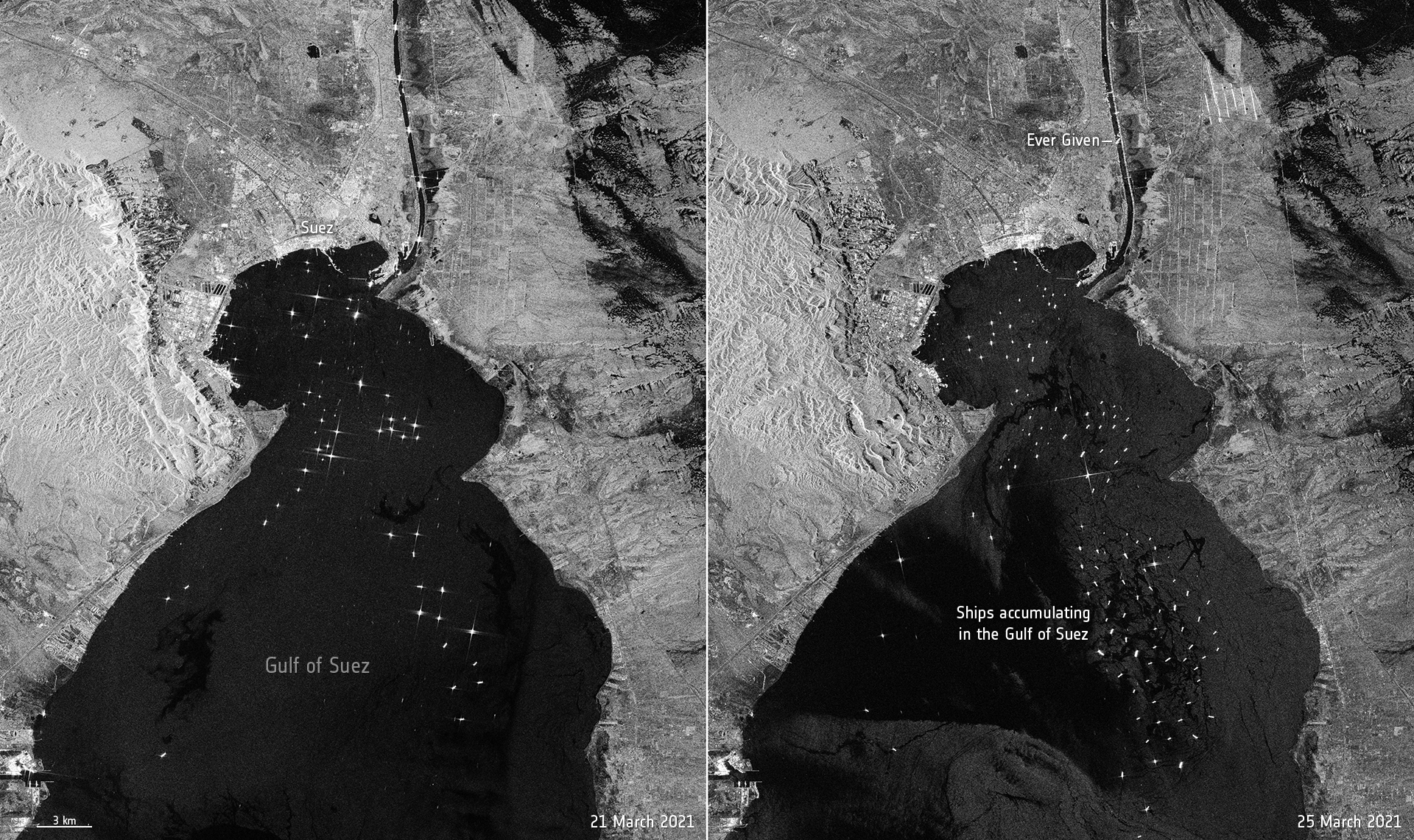
Suez Canal, Egypt
Ever Given Blocks Suez Canal
$9.6B in trade blocked per day · 422 vessels queued · 12% of global trade halted
On March 23, 2021, the 400-meter container ship Ever Given ran aground diagonally across the Suez Canal during a sandstorm, blocking it completely for 6 days. Maersk and other carriers began emergency rerouting around the Cape of Good Hope — adding up to 14 days and significant fuel cost per voyage. Salvage crews worked continuously, and the ship was freed on March 29 by a combination of dredging, tugboats, and a favorable high tide.
Single chokepoints in global trade carry systemic risk that is rarely priced in until failure happens — the Suez carries 12% of global trade through a corridor that can be blocked by a single ship.

TSMC fabs, Taiwan · Auto plants globally
Global Semiconductor Shortage
$210B in lost auto revenue · 13M vehicles not built · 52-week wafer lead times
In spring 2020, auto makers cancelled chip orders expecting a demand collapse. Consumer electronics demand surged instead, and TSMC reallocated capacity to smartphones and laptops. When auto demand returned by Q4 2020, there was no fab capacity left — wafer lead times stretched to 52 weeks. GM and Ford idled assembly plants. Toyota, which had maintained 2–6 months of chip inventory since its 2011 Fukushima protocol, weathered the shortage far better than competitors.
Inventory buffers aren't waste — Toyota's post-Fukushima stock discipline saved billions while 'efficient' lean competitors lost production. Resilience and efficiency are genuinely in tension.

Tōhoku Region, Japan
Tōhoku Earthquake — Auto Supply Chain Collapse
260,000 Toyota vehicles halted · Renesas shut 6 months · specialty pigment disrupted 18 months
The magnitude-9.0 earthquake and tsunami devastated Tōhoku. Renesas Electronics (a key auto chip supplier) shut down for months and was widely reported as the main bottleneck. Less visible: a Merck plant in Onahama was the sole global source of a specialty pigment used in automotive paint. When it went offline, car color options were globally constrained for 18 months. Companies that had mapped only their tier-1 suppliers discovered they had critical single-source dependencies two and three tiers upstream that they had never tracked.
The hidden fault was not the obvious failure. Renesas was survivable — the specialty pigment bottleneck was the real killer, and nobody was watching it because nobody had mapped that far upstream.

Nakhon Ratchasima & Pathumthani, Thailand
Thailand Floods Destroy HDD Production
HDD prices tripled · PC shipments fell 30% globally · 18-month recovery
Thailand produced 40% of the world's hard disk drives from industrial estates in the Chao Phraya river basin. When monsoon flooding hit in October 2011, both Western Digital and Seagate facilities were submerged — along with the component suppliers concentrated in the same geography. HDD prices tripled within 6 weeks. PC manufacturers HP and Dell saw Q4 shipments collapse. The shortage lasted 18 months because rebuilding a clean-room HDD facility requires 18+ months of qualification and environmental validation.
Geographic concentration of suppliers compounds single-point failure risk. When the region fails, every 'alternative' supplier fails simultaneously — because they're all in the same region.
Strait of Hormuz, Persian Gulf
Iran Strait of Hormuz Crisis
Oil +25% · 6 tankers attacked · War insurance ×10 · 5.7M bbl/day Aramco offline
US sanctions reimposed on Iran in 2018 triggered an escalating maritime campaign. By June 2019, IRGC forces attacked two tankers in the Gulf of Oman using limpet mines. The UK-flagged Stena Impero was seized. In September 2019, Houthi/IRGC drone strikes hit Saudi Aramco's Abqaiq and Khurais facilities — briefly taking 5.7 million barrels per day offline (5% of global supply). War risk insurance premiums for tankers in the Gulf jumped 10×. The Strait of Hormuz — 33km wide at its narrowest, carrying 21% of global petroleum — became the world's most watched chokepoint.
Geopolitical chokepoints carry tail risk that insurance cannot fully price. War risk premiums rising 10× signal that the market has lost confidence in safe passage — the right response is rerouting, not paying more to run the same route.
Global
COVID-19 Global Supply Chain Collapse
Shipping rates ×7 · Container shortage · Port dwell times tripled · $4T in delayed goods
The COVID-19 pandemic created a supply chain crisis unlike anything in modern history. It started with factory shutdowns in Wuhan (January 2020), then spread globally as lockdowns began. Simultaneously, consumer demand patterns inverted: toilet paper, PPE, electronics, and home fitness equipment surged while automotive, aerospace, and hospitality collapsed. Containers accumulated at ports as import volumes surged but export loads declined, creating a massive container imbalance. Port dwell times tripled as truck driver shortages and labor unavailability created bottlenecks even after goods arrived. Shipping rates for a 40-foot container from Shanghai to Rotterdam rose from $2,000 in January 2020 to over $15,000 by late 2021. The Federal Reserve estimated $4 trillion in delayed or disrupted goods.
Just-in-time has no buffer. When a simultaneous multi-node disruption hits, companies with any inventory buffer — even 2 weeks — survived. JIT companies shut down for $5 chips. Safety stock is not waste; it is optionality.
One bad supplier. Five dominoes.
It's been broken for weeks. You just found out.
The worst thing you can do right now is act.
They both need it. You can't give both.
They heal each other. Until they don't.
Pressure compounds. Every tick, faster.
Every tick, stressed nodes transmit pressure along edges. One fragile upstream supplier can cascade through your entire network before you realize it's started.
Fragile nodes collapse fast. Resilient nodes absorb and recover. Oscillatory nodes spike unpredictably. Saturated nodes burst. Each archetype requires a different response.
Reinforce, buffer, decouple, investigate — you get a handful each game. Spend them on symptoms and you'll lose to the root cause. Spend them right and the system holds.
Most people encounter supply chains only when they fail — a part doesn't arrive, a product vanishes from shelves, a factory goes dark for reasons nobody explains well. The complexity that underlies these events is real and poorly understood, even by many of the people managing them.
This game is a model of that complexity. Not a perfect one — no model is. But it captures something true: pressure propagates, archetypes behave differently under stress, and the right intervention at the wrong moment makes things worse. These patterns come from studying actual industrial failures. The scenarios are constructed. The dynamics are borrowed from real systems.
The goal isn't just entertainment. Every time someone plays, they're building intuition about where networks break and what actually holds them together. That intuition has real value — whether you're a COO deciding where to buffer inventory, an analyst trying to understand why a manufacturer missed guidance, or just someone trying to make sense of why the thing you ordered took three months to arrive.
Collectively, the more people play, the more we learn about how humans reason under pressure — which interventions feel right, which ones people reach for first, and where intuition consistently fails. That data is interesting. The game is the vehicle.
First to die. Always your first priority.
Spikes unpredictably. Watch the trend.
Passes pressure through. It's a pipe, not a problem.
Self-recovers. Don't waste actions here.
Will burst. The wave hits downstream.
Amplifies ×1.8. Stop the input.
Natural valve. Keep it alive.
Hidden until it's too late. Investigate.
What would make this more useful? New scenarios, mechanics, educational features — anything. Good ideas get built.
// no ideas yet — be the first